How Much Is an EV Fast Charger in India 2026: Price and ROI Guide

Shruti Menon
Associate Manager - Content
Published on:
16 Jul, 2026
Updated on:
05 Oct, 2026

Explore this content with AI:
TL;DR
- Hardware price range: ₹8,000 (basic smart AC charger) to ₹25 lakh+ (high-power DC/ultra-fast charger).
- Home recommendation: Smart AC charger (3.3-7.4kW) for overnight charging.
- Commercial recommendation: DC fast chargers with software and network management.
- Total cost of ownership: Includes installation, cabling, electrical upgrades, networking, and maintenance.
- ROI: Commercial installations can recover costs through charging revenue when utilization is high.
How much is the cost of a fast charger?
The answer depends on what you mean by “fast charger.”
Many people assume every EV charger is a fast charger, but that’s not true. A charger designed for home and one installed at a highway charging station are built for completely different purposes.
Here’s a quick overview of typical 2026 price ranges in India.
Important: These figures are for hardware only. Installation, electrical upgrades, transformer needs, networking, and maintenance can significantly increase total project cost.
This guide will help you understand the cost of the charger, installation, operation, and maintenance.
Charger Types and Typical Project Costs
1. Smart Home AC Chargers
Most homeowners don’t actually need a DC fast charger.
Instead, they install a smart home AC charger that safely charges the vehicle overnight.
Typical features include:
- Smart scheduling
- Mobile app integration
- Usage monitoring
- Remote access
- Safety protections
- Future software updates
Typical Price
The final amount depends largely on the distance between the electrical panel and the parking space, the quality of existing wiring, and whether additional electrical work is required.
2. Commercial AC Chargers
Commercial properties often install higher-capacity AC chargers to serve employees, visitors, or customers.
These chargers usually include:
- User authentication
- Remote monitoring
- Billing
- Access control
- Load management
- Cloud connectivity
Typical Price
3. DC Fast Chargers
DC chargers deliver much higher power directly to an EV’s battery, dramatically reducing charging time.
They’re commonly installed at:
- Highway charging stations
- Fuel stations
- Fleet depots
- Commercial parking facilities
- Public charging hubs
Because of their higher power output, they require considerably more infrastructure than an AC charger.
Typical Price
Large installations may also require a dedicated transformer, additional sanctioned electrical load, civil work, networking equipment, and utility approvals, all of which increase project costs.
4. Ultra-Fast Chargers
Ultra-fast chargers are designed for locations where vehicles need the shortest possible charging time.
Typical deployment locations include:
- National highways
- Expressways
- Bus depots
- Logistics hubs
- Large commercial charging plazas
Typical Price
These systems are typically viable only where there is consistently high charger utilization and strong demand from EV users.
Estimated Total Project Cost
These figures are indicative and vary based on site conditions, local labor costs, electrical upgrades, and charger specifications.
Fast Charger Pricing by Vehicle Type
The “best” charger depends on what you’re charging.
Buying a 60kW DC charger to charge a scooter isn’t practical, just as installing a 3.3kW home charger for a commercial fleet would create long waiting times.
Let’s look at each category in the table below.
What Drives the Cost of a Fast Charger?
Two chargers may appear similar but have vastly different prices because of differences in technology, capabilities, and infrastructure requirements.
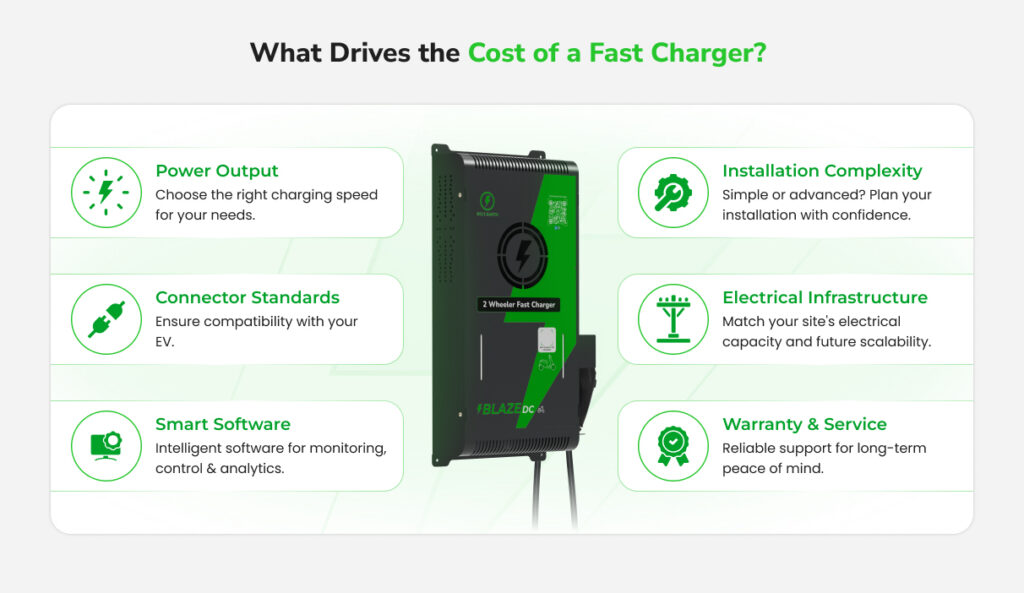
Here are the biggest cost drivers.
1. Power Output: Higher power needs larger components, better cooling, and heavier cabling. As charger power increases, costs rise significantly.
2. Connector Standards: Different EVs support different charging standards. Multiple connector units cost more.
3. Smart Software: Modern chargers are more than power delivery devices. Features like remote monitoring, OTA software updates, billing, etc., not just improve long-term usability but also influence price.
4. Installation Complexity: Long cable runs, underground, and civil work raise costs.
5. Electrical Infrastructure: A DC fast charger often requires a three-phase supply, higher sanctioned load, additional distribution panels, and transformer upgrades, which account for increased expense.
6. Warranty and Service: Cheaper chargers may reduce upfront costs but often provide limited after-sales support. Longer warranties, faster service response time, etc., raise upfront cost but lower lifetime risk.
ROI Considerations: Is a Fast Charger a Good Investment?
One of the biggest questions people ask before buying an EV charger is:
“Will I recover my investment?”
The answer depends on how the charger is used.
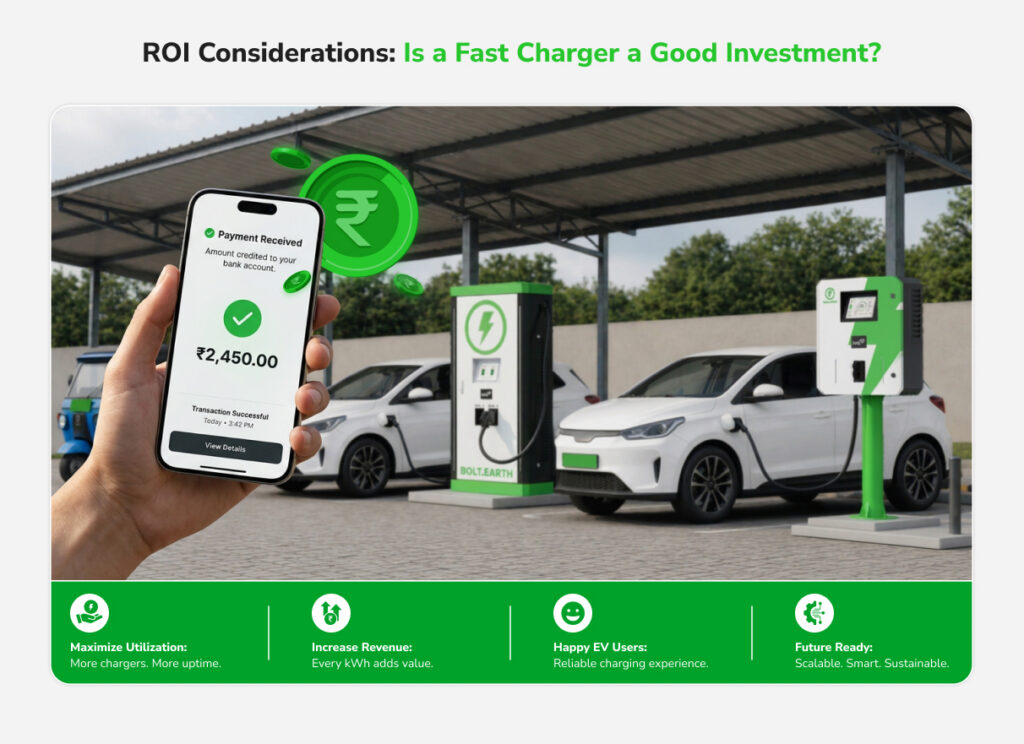
Home installations deliver value mainly through convenience and lower per‑kWh costs; commercial and fleet installations can also generate direct revenue. Utilization is the single most important factor.
Representative Scenarios
Estimate Your Payback for Your Use Case
The examples above are indicative and actual payback depends on factors such as charger utilization, electricity tariffs, installation costs, and charging fees.
For homeowners, returns typically come from sharing a private charger with neighbours or tenants and recovering the difference between domestic electricity tariffs and commercial charging rates.
Commercial charging hubs, on the other hand, rely on higher daily charger utilization to recover infrastructure costs, while high-power DC charging deployments generally have longer payback periods due to their significantly higher upfront investment.
If you’re evaluating an EV charging setup, you can use the Bolt.Earth ROI Calculator to estimate the expected payback period based on your deployment type. You can also explore our guide on how to save money on EV charging for practical ways to reduce charging costs and improve long-term value.
Future Pricing Trends 2026 to 2030
EV charging technology is evolving rapidly. As adoption increases, both hardware and installation practices are becoming more efficient.
Here’s what consumers can expect over the next few years.
- Affordable Hardware: Charger costs are likely to fall as domestic manufacturing scales.
- Smarter Chargers: With AI energy management, dynamic load balancing, and better diagnostics, chargers will get smarter and increasingly software-driven. These features can improve reliability while reducing maintenance costs.
- Better Grid Integration: Utilities are gradually preparing for larger EV loads. With dedicated EV tariffs and smarter metering, grid integration will improve. These developments could reduce long-term charging costs for consumers.
- Government Support: State incentives and policy support will continue to influence deployment economics, encouraging broader installations of residential and commercial charging infrastructure.
Pre-Purchase Checklist
Before investing in any EV charger, ask yourself:
- What type of EV will use the charger
- How many vehicles will use it and expected daily sessions
- Distance from electrical panel to parking spot
- Sanctioned electrical load available
- Future speed requirements and upgrade path
- Need for app‑based monitoring and billing
- Compatibility with vehicle connector standards
- Installation and electrical upgrade budget included
- Revenue model if commercial
- Manufacturer service and software support
Answering these before you buy will help avoid unnecessary costs and ensure the installation meets future needs.
Final Thoughts
Fast chargers are becoming more accessible as India’s EV ecosystem continues to mature.
Always evaluate the total cost of ownership, including hardware, installation, electrical upgrades, software, and maintenance, rather than the hardware price alone.
For most homeowners, a smart AC charger is the most cost-effective choice; businesses and fleets should plan DC deployments only where utilization and site conditions justify the investment.
A fast charger’s right specification depends on vehicle type, charging frequency, available electrical capacity, and whether the installation is for personal use or commercial revenue. A well-planned charging setup not only improves your EV ownership experience today but also prepares you for tomorrow’s growing electric mobility landscape.
If you’re comparing charger options or planning a new installation, consider Bolt.Earth’s wide range of EV charging solutions designed for homes, apartments, businesses, fleets, and public charging networks, helping you choose the most cost-effective solution based on your unique requirements.

Frequently Asked Questions
How much is a fast charger for an electric car?
Prices typically range from ₹8,000 for basic smart AC chargers to over ₹25 lakh for high-power commercial DC fast chargers, depending on power output and infrastructure requirements.
How much does an electric car charging station cost?
A complete installation can cost anywhere from ₹15,000 for a simple residential setup to several lakh rupees for commercial installations, depending on site conditions and charger type.
What is the EV charging cost per unit in India?
Residential charging is generally cheaper per unit than public fast charging because household electricity tariffs are lower. Commercial tariffs must cover infrastructure and operating costs, resulting in a higher cost per unit.
Is investing in an EV charger worth it?
For homeowners, the benefits are convenience and lower operating cost. For businesses and fleets, chargers can generate revenue when utilization is high and operations are well managed.

Oct 22, 2026 • EV Charging Infrastructure
How to Prevent EV Charger Theft: 7 Smart Security Tips for EV Owners
Read More
Oct 13, 2026 • EV Charging Infrastructure
Portable EV Charger, EV Wall Box Charger, Fast Charging: What They Are and What Makes Sense for You
Read More
Sep 30, 2026 • EV Charging Infrastructure
EV Charger Buying Checklist: Everything to Compare Before You Purchase
Read More