How Long Does It Take to Charge an EV?

Shruti Menon
Associate Manager - Content
Published on:
22 Jul, 2026
Updated on:
30 Jul, 2026

Explore this content with AI:
It is 8 in the morning, and you are getting ready to leave for work. You glance at your EV and notice the battery is down to 20%. Your first thought is simple:
“How long will it take to charge?”
The answer isn’t as straightforward as filling up a petrol or diesel vehicle. Charging an EV depends on several factors, including the size of the battery, the type of charger you’re using, how much charge is already left, and even the weather outside.
That’s why two people charging similar EVs can experience very different charging times.
The good news? Once you understand what affects charging speed, estimating charging time becomes much easier.
In this guide, we’ll explain how long it typically takes to charge an EV, compare different charging methods, explore what influences charging speed, and share practical tips to help you spend less time waiting and more time driving.
TL;DR
- There’s no single answer; charging time depends on battery size, charger power, current battery percentage, and temperature.
- A full home AC charge (7.2 kW) typically takes 5–9 hours; most owners charge overnight, so this rarely matters in practice.
- DC fast charging can take a battery from 10–80% in 18–60 minutes, depending on the vehicle and charger.
- Charging always slows down after roughly 80%; this is normal battery behavior, not a fault.
- Popular Indian EVs like the Tata Nexon EV and MG Windsor EV fast-charge 10–80% in 40–50 minutes; newer 800V models like the Mahindra BE 6 and Kia EV6 do it in 18–20 minutes.
- Most EV owners never charge from 0% to 100%; they “top up” like a phone, not “refuel” like a petrol tank.
- Cold and extremely hot weather can slow charging by 10–30% due to battery thermal management.
- India’s Ministry of Power mandates open protocols (OCPP, OCPI) and standard connectors (CCS-2, Bharat AC-001/DC-001) to keep public charging interoperable.
- Charging between 20% and 80% is the sweet spot for speed and long-term battery health.
- Home charging plus occasional public fast charging covers nearly all real-world Indian driving needs.
Typical Charging Time for an EV in India
In most cases, a full charge takes 5–9 hours at home overnight, or 20–60 minutes at a public DC fast charger for a 10–80% top-up.
Exact times vary by vehicle and battery size; a small 30kWh battery and an 80kWh battery will never charge in the same time on the same charger.
Factors That Determine EV Charging Speed?
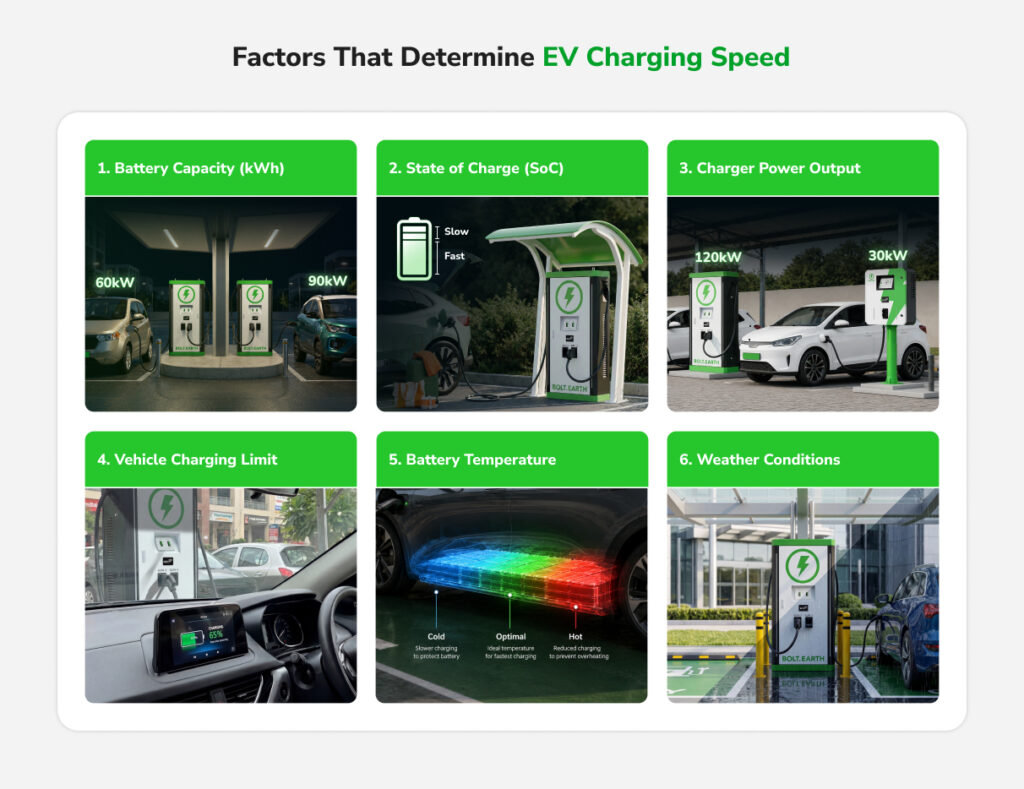
- Battery Capacity (kWh)
Think of the battery as a water tank. A 40kWh battery is a smaller tank than an 80kWh battery. Pouring water in at the same rate (the same charger) naturally fills the bigger tank more slowly; not because anything is wrong, but because there’s simply more space to fill.
- State of Charge (SoC)
Charging isn’t linear. Batteries charge fastest between roughly 20% and 80%, then progressively slow down between 80–100%. This happens because the battery management system (BMS) reduces power near full charge to protect the cells from stress and heat; similar to how water fills a glass quickly at first, then must be poured carefully to avoid overflowing near the brim.
- Charger Power Output
The higher the charger’s power rating (measured in kW), the faster energy flows in; up to the vehicle’s limit.
- Vehicle Charging Limit
Even if a charger can deliver 150kW, the car decides how much power it actually accepts. Every EV has a maximum charging rate built into its onboard electronics and battery chemistry. Plugging a car rated 60kW into a 150kW charger won’t make it charge any faster than 60kW allows.
Note: most mass-market Indian EVs feature an onboard AC charger capped at 7.2 kW or 11 kW. This means if a user plugs a basic EV into a 22kW public AC charger, it will still only draw power at their car’s specific 7.2kW or 11kW limit.
- Battery Temperature
Lithium-ion batteries charge best within a specific temperature range. A very cold battery accepts charge more slowly because the battery management system limits power to avoid damaging the cells; a very hot battery may also throttle charging speed to prevent overheating. This is why some EVs “precondition” the battery, warming or cooling it, before a planned fast-charging stop.
- Weather Conditions
Indian conditions add real-world variability. Peak summer heat (especially in cities like Delhi or Nagpur) can trigger thermal throttling during fast charging. Monsoon humidity generally doesn’t affect charging speed directly but can affect outdoor charger uptime. Winter mornings in northern India can slow charging speed until the battery warms up.
AC Charging vs DC Fast Charging
Read more in detail: Fast Charging vs. Slow Charging: What Fits Your Lifestyle?
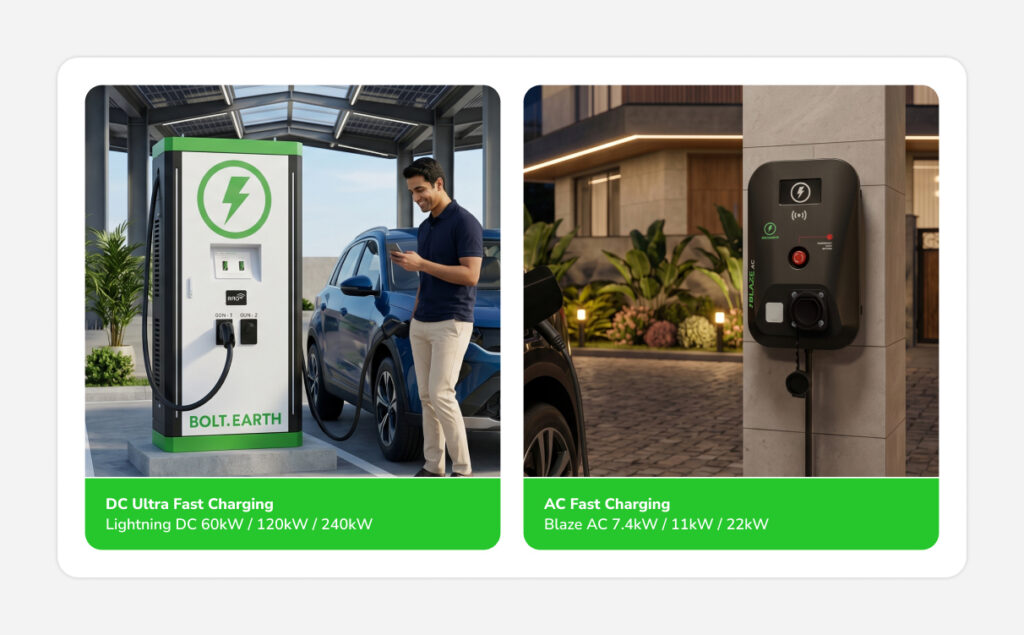
As per Ministry of Power guidelines, all new public chargers in India must support open protocols (OCPP for charger-to-backend communication, OCPI for roaming) and standardized connectors such as CCS-2 for four-wheelers and Bharat AC-001/DC-001 for two- and three-wheelers, ensuring any compatible EV can use any compliant charger.
How to Calculate EV Charging Time Yourself
Estimating charging time takes three numbers: your battery capacity, how much charge you need, and your charger’s power rating — adjusted for the energy that charging loses as heat in the cables, connectors, and onboard charger (typically 10–15%). That gives you one formula:
Charging Time = [Battery Capacity × (Target % − Current %)] ÷ (Charger Power × Efficiency)
For example:
A 45kWh battery charging from 20% to 80% on a 7.2 kW home charger at 90% efficiency.
It needs 27 kWh (45 × 0.6), so charging takes 27 ÷ (7.2 × 0.9) ≈ 4.2 hours; about 4 hours 10 minutes, roughly 25 minutes longer than the 3.75-hour “textbook” figure you’d get by ignoring efficiency.
This formula works for any charger- home AC, public AC, or DC fast charging; just swap in the power rating.
Note: it gives a straight-line estimate. Real DC fast-charging sessions run a little longer near the top of the range, since charging speed tapers off past roughly 80%, as covered above.
Charging Times for Popular Indian EVs
Note: Figures are taken from official websites/documents pertaining to the manufacturers.
The 20–80% EV Charging Rule: Why It’s Enough for Daily Driving
Unlike petrol or diesel vehicles, EVs aren’t refueled from empty to full. Most owners simply “top up” whenever convenient – overnight at home, during work hours, or while running errands. This habit is practical and also aligns with how EV batteries perform best.
Charging between 20% and 80% is faster, gentler on the battery, and sufficient for daily driving. Regularly charging only to 80% for daily use and reserving 100% charges for longer trips reduces stress on the battery and takes advantage of the fact that charging past 80% is the slowest, least efficient part of the curve anyway.
Pro Tip:
For everyday driving, charging between 20% and 80% helps balance convenience, charging speed, and long-term battery health.
Tips to Reduce EV Charging Time
- Precondition the battery before fast charging, if your EV supports it.
- Avoid charging to 100% daily; it adds time with little benefit.
- Use DC fast charging for road trips or emergencies, not routine daily charging.
- Plan charging stops around the 20–80% window for maximum speed.
- Install a home AC charger rather than relying solely on a standard socket; it cuts time by more than half.
- Charge overnight to benefit from off-peak tariffs.
- Use smart/scheduled charging where available to charge during cooler hours or cheaper tariff windows.
Common Myths About EV Charging in India
Final Thoughts
There’s no single answer to “how long does it take to charge an EV”. It depends on battery size, charger type, how much power your vehicle can accept, current battery percentage, and even the weather. The consistent pattern is clear; AC charging is slower but convenient for overnight use or where vehicle is parked for longer hours, while DC fast charging offers speed at a premium.
In practice, most EV owners don’t wait for a full charge; they simply plug in when it’s convenient and unplug when they have enough charge (just like a mobile phone). With the right mix of home and public charging, powering an EV becomes part of daily life rather than something you have to plan your day around.

Frequently Asked Questions
Can I charge my EV overnight?
Yes. Overnight charging with a home AC charger is the most common and convenient method for most EV owners. It typically takes 5–9 hours depending on battery size, well within an overnight window.
Should I charge my EV to 100%?
Not daily. Charging to 80% is faster and gentler on the battery. Charge to 100% only when you need extra range for long trips.
Why does charging slow down after 80%?
The battery management system reduces power to protect the battery from excess heat and stress, similar to carefully topping off a full glass.
How much range do I get in 30 minutes of fast charging?
It depends on the vehicle and charger, but many modern EVs add 100–250 km in 30 minutes on a compatible DC fast charger.

Sep 30, 2026 • EV Charging Infrastructure
EV Charger Buying Checklist: Everything to Compare Before You Purchase
Read More
Sep 11, 2026 • EV Charging Infrastructure
Charging During Power Cuts: What Actually Happens and How to Plan Ahead
Read More
Sep 08, 2026 • EV Charging Infrastructure
Best Ways to Set Up an EV Charging Infrastructure
Read More