Guidelines for Installation and Operation of Electric Vehicle Charging Stations in India

Shruti Menon
Associate Manager - Content
Published on:
24 Jul, 2026
Updated on:
06 Oct, 2026

Explore this content with AI:
An EV charging station is only as reliable as the infrastructure behind it. While the charger is the most visible component, the quality of electrical planning, grid connectivity, safety systems, software integration, and ongoing maintenance ultimately determines its performance.
As EV adoption grows across India, charging infrastructure is becoming a critical utility for businesses, residential communities, fleet operators, and public spaces. Building it correctly from the outset reduces downtime, improves safety, and protects long-term investment.
This guide explains the regulatory framework, technical installation requirements, operational best practices, and key considerations for installing and operating EV charging stations in India.
TL;DR
Before installing an EV charging station, keep these essential guidelines in mind:
- Plan your site’s electrical capacity before selecting a charger.
- Use chargers that comply with recognized Indian and international safety standards such as IS 17017 and IEC 61851.
- Install dedicated electrical circuits with proper earthing, RCCBs, MCBs, and surge protection devices.
- Work with your local DISCOM if your project requires a new or upgraded electricity connection.
- Design charging infrastructure that can accommodate future EV growth without major reconstruction.
- Choose interoperable chargers that support Open Charge Point Protocol (OCPP) for greater software flexibility.
- Schedule routine inspections, preventive maintenance, and firmware updates to improve charger reliability.
- Use smart charging and dynamic load balancing to optimize electricity usage and reduce peak demand.
- Follow both national guidelines and state-specific building, electrical, and fire safety regulations.
- Remember that reliable charging infrastructure depends as much on planning and operations as it does on the charger itself.
Regulatory Framework for EV Charging
Installing an EV charging station in India does not require the same approvals as setting up a traditional fuel station. However, every installation must comply with electrical safety regulations, recognized technical standards, and local requirements applicable to the project.
India’s regulatory framework aims to achieve three primary objectives:
- Ensure safe charging for people and vehicles.
- Maintain the reliability of the electricity distribution network.
- Encourage the development of an accessible and interoperable charging ecosystem.
Multiple organizations work together to establish these guidelines.
- Ministry of Power (MoP): Defines the overall framework for installing and operating EV charging infrastructure, covering deployment, electricity connections, tariff principles, interoperability, and public charging infrastructure.
- Central Electricity Authority (CEA): Focuses on electrical safety, specifying how charging stations should connect to the electricity network and outlining requirements for protection systems, earthing, equipment installation, and inspections.
- Bureau of Energy Efficiency (BEE): Acts as the central nodal agency working with state governments and urban local bodies to support planning and deployment.
- Bureau of Indian Standards (BIS): Publishes Indian standards that align with international IEC standards, ensuring compatibility and safety.
- Automotive Research Association of India (ARAI): Supports testing and certification of EV technologies and contributes to automotive standards that improve vehicle and charger compatibility.
Together, these organizations create a framework that encourages safe, reliable, and interoperable charging infrastructure across India.
National and State Guidelines
Although the Ministry of Power has made EV charging a de-licensed activity, implementation often depends on state governments, electricity distribution companies (DISCOMs), municipal authorities, and building regulations.
For example, a homeowner installing a single AC charger may only need to comply with safety standards. In contrast, a commercial property installing multiple DC fast chargers may require transformer upgrades, fire safety clearances, parking approvals, and coordination with the local DISCOM.
Several national standards play an important role in EV charging infrastructure:
- What does IS 17017 mean?
IS 17017 specifies safety and performance requirements for EV charging systems in India.
- What does IEC 61851 mean?
IEC 61851 defines how EV charging equipment supplies electricity safely and communicates with electric vehicles.
- What does IEC 62196 mean?
IEC 62196 standardizes charging connectors and sockets, improving compatibility across EV models.
Understanding the Role of DISCOMs
Electricity Distribution Companies, commonly known as DISCOMs, play an important role in assessing whether the local electricity network can safely support additional load from large commercial charging installations. They may recommend transformer upgrades, new service connections, or infrastructure changes.
Early engagement with DISCOM helps avoid project delays and unexpected costs.
Technical Requirements for Installation
A successful EV charging station installation depends on more than selecting the right charger.
Before installation begins, evaluate these five key factors:
- Available electrical capacity
- Expected charging demand
- Type of charger (AC or DC)
- Future expansion plans
- Compliance with safety standards
A detailed site assessment by a qualified electrical professional is essential before any equipment installation.
Power Supply and Grid Integration
Every EV charger draws power from the electricity grid. The electrical infrastructure must therefore be capable of supplying the required load safely and consistently without affecting other electrical systems within the building.
What Is Grid Integration?
Grid integration refers to the process of connecting EV charging infrastructure to the electricity network while ensuring that the grid continues to operate safely and efficiently.
Without proper planning, several vehicles charging simultaneously can create sudden spikes in electricity demand. These spikes may overload transformers, reduce voltage quality, and increase electricity costs for both the charging station operator and the distribution network.
- Dedicated Electrical Circuits
Each EV charger should have its own circuit with protection devices. This improves:
- Electrical safety
- Charger reliability
- Fault isolation
For commercial charging stations, each charger should also have clearly labeled isolation switches that allow maintenance teams to safely disconnect power whenever servicing is required.
- Single-Phase vs. Three-Phase Power
Residential AC chargers typically use single-phase power, while DC fast chargers and fleet depots require a three-phase supply for higher charging speeds.
- Transformer Capacity
Large charging installations may require transformer upgrades or dedicated transformers. Ignoring transformer capacity risks voltage fluctuations and unreliable performance.
- Smart Charging
Smart charging uses software to optimize when and how electric vehicles charge.
Instead of delivering maximum power continuously, the system adjusts charging based on:
- Grid capacity
- Available electrical load
- Electricity tariffs
- Number of connected vehicles
- Charging priorities
For example, if ten vehicles begin charging at the same time in an office parking lot, smart charging can distribute available power across all chargers instead of overloading the electrical infrastructure.
This approach improves reliability while reducing operating costs.
- Dynamic Load Balancing
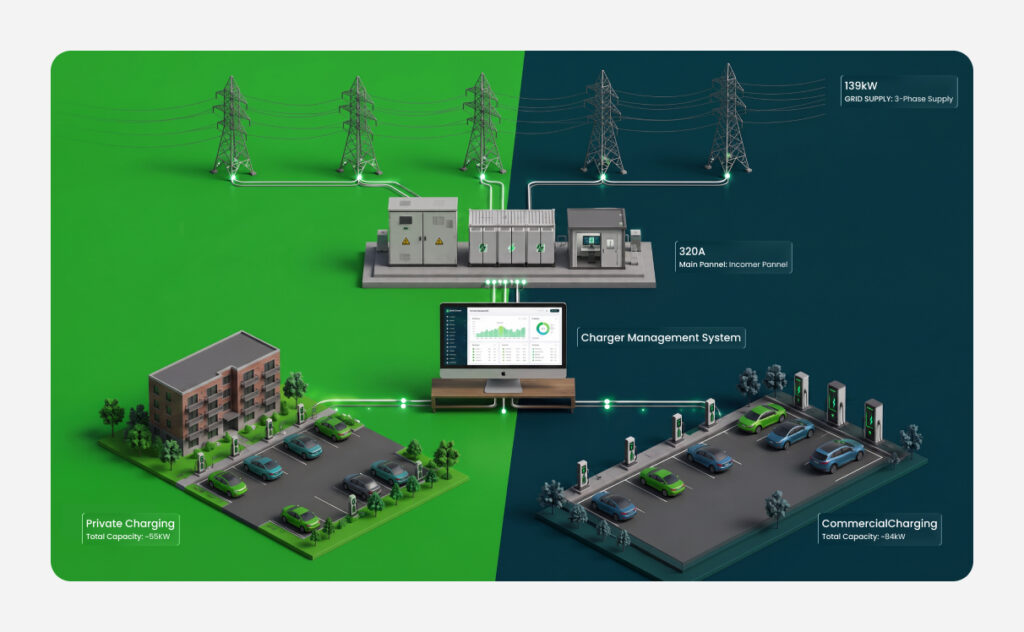
One of the most effective tools for managing multiple chargers is Dynamic Load Balancing (DLB).
Dynamic load balancing continuously monitors the building’s electricity consumption and automatically distributes available power among connected chargers to prevent overloads and reduce demand charges.
For example: a commercial building with a total electrical capacity of 200kW. During office hours, lighting, air conditioning, elevators, and other equipment may already consume 140kW. Instead of allowing EV chargers to draw an additional 100kW and overload the system, dynamic load balancing intelligently allocates only the remaining available capacity to the chargers.
When the building’s electricity demand decreases later in the evening, the system automatically increases charging power.
This provides several benefits:
- Prevents electrical overload
- Delays expensive transformer upgrades
- Reduces demand charges
- Maximizes charger utilization
- Improves overall energy efficiency
- Integrating Renewable Energy
Many businesses now combine EV charging infrastructure with rooftop solar and Battery Energy Storage Systems (BESS).
While solar-generated electricity directly powers chargers during daylight hours, reducing dependence on grid electricity and lowering operating costs, BESS stores excess solar energy and releases it when charging demand increases.
This combination offers several advantages:
- Lower electricity bills
- Reduced peak demand
- Improved renewable energy utilization
- Greater energy resilience during grid fluctuations
Effective power and grid integration isn’t just about meeting today’s charging needs; it’s about preparing for tomorrow’s. Evaluating available electrical capacity and designing for future growth ensures reliable operations, minimizes upgrade costs, and supports the continued expansion of EV charging infrastructure.
Safety Standards
Every EV charging station handles high-voltage electricity, often in outdoor environments where people interact directly with charging equipment. Thus, safety is not negotiable.
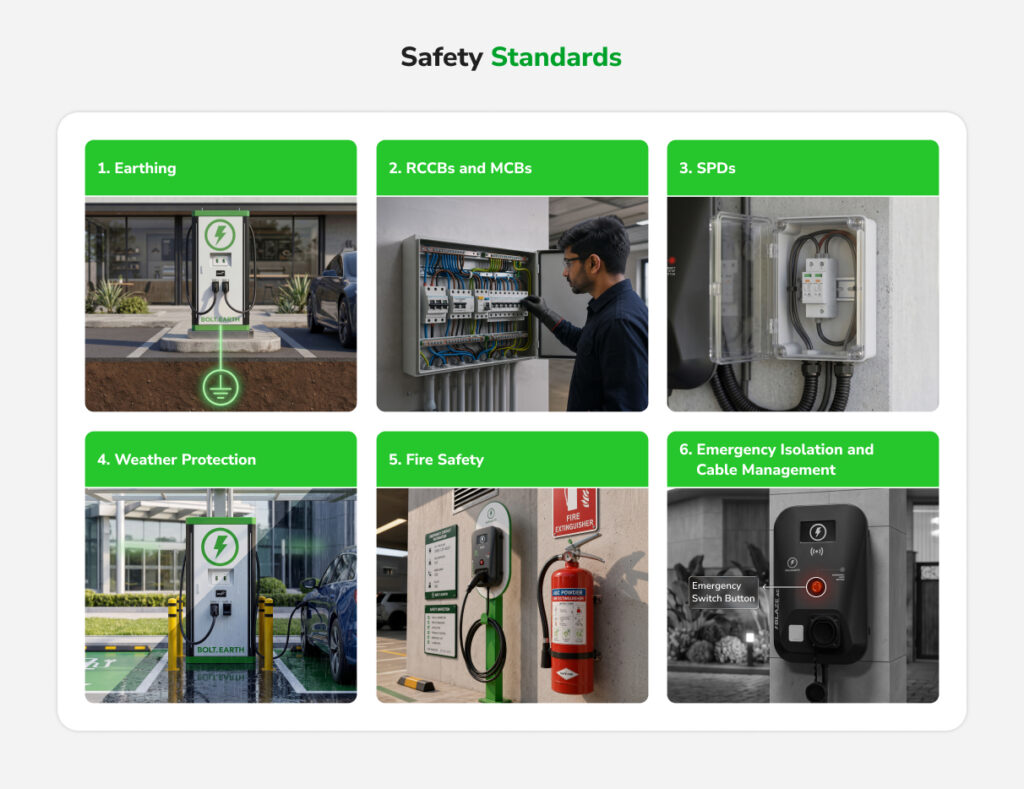
Essential safety measures include:
- Earthing
Earthing provides a safe path for fault current to flow into the ground if an electrical fault occurs. Without effective earthing, users may face electric shock hazards, and sensitive electronic components inside the charger can suffer permanent damage. Earthing systems should be tested periodically to ensure they continue to perform effectively over time.
- Residual Current Circuit Breakers (RCCBs)
An RCCB detects earth leakage currents and disconnects the power instantly. This rapid response significantly reduces the risk of electric shock.
- Miniature Circuit Breakers (MCBs)
An MCB protects against overloads and short circuits. If excessive current flows through the circuit, the MCB automatically interrupts the power supply before cables or electrical equipment is damaged.
- Surge Protection Devices (SPDs)
Voltage surges can occur due to lightning strikes, switching operations, or grid disturbances. Although these surges may last only a fraction of a second, they can damage expensive electronic components inside EV chargers. Installing Surge Protection Devices (SPDs) helps protect chargers from unexpected voltage spikes and reduces repair costs. This is especially important in regions that experience frequent thunderstorms.
- Weather Protection
Many EV charging stations operate outdoors throughout the year. Charging equipment should therefore have appropriate Ingress Protection (IP) ratings to resist rain, dust, humidity, and temperature variations.
- Emergency Isolation and Cable Management
Every charging station should include clearly accessible emergency shut-off switches that allows operators to disconnect power during emergencies or maintenance activities.
Proper cable management is equally important. Loose charging cables create trip hazards, increase wear and tear, and may become damaged if vehicles drive over them repeatedly.
Simple measures such as cable hooks, retractable cable systems, or overhead cable management improve both safety and user experience.
- Fire Safety
Although EV chargers are designed with multiple layers of protection, operators should still prepare for electrical emergencies.
Commercial charging stations should include:
- Appropriate fire extinguishers
- Clearly marked emergency exits
- Adequate ventilation
- Emergency contact information
- Regular safety inspections
A well-maintained charging station is significantly less likely to experience fire-related electrical incidents than one with neglected maintenance.
Operational Best Practices
Installing an EV charger is only the beginning. The real challenge is keeping it safe, reliable, and available every day.
A charger that frequently goes offline or develops faults can frustrate users, reduce revenue, and increase maintenance costs. Preventive maintenance, monitoring, and good user experience help improve charger uptime and extend the life of the equipment.
- Maintenance and Monitoring
Routine inspections prevent small issues from becoming major failures. Maintenance should include visual checks, cable inspections, testing protection devices, cleaning connectors, and verifying emergency systems. Keeping the charger software updated is equally important for performance and cybersecurity.
- Remote Charger Monitoring and Data Use
Many networked chargers allow operators to track availability, faults, and energy usage remotely.
This enables operators to identify and resolve issues quicker, reducing downtime, and improving customer service.
Analyzing this data supports better planning, improving maintenance scheduling, and helping businesses make informed decisions about future expansion.
- Spare Parts and Technical Support
Even well-maintained chargers may require occasional repairs. Keeping essential spare parts and service agreements readily available ensures quick resolution of faults, reducing downtime and protecting revenue.
- User Experience and Accessibility
A reliable charging station must also be user-friendly. Clear signage, accessible layouts, good lighting, and multiple payment options (mobile applications, QR code-based payments, UPI, credit or debit cards, RFID cards, fleet accounts, or subscriptions) ensure less friction and more convenience.
Similarly, having responsive customer support builds trust and encourages customers to return to the charging network.
Businesses planning multiple charging stations should improve reliability by adopting interoperability through the Open Charge Point Protocol (OCPP). OCPP is an open communication standard that allows chargers to integrate with different charging management systems instead of being tied to a single software provider. This flexibility ensures greater reliability, scalability, and futureproofing for charging networks.
- Building for Long-Term Growth
Ev adoption will continue to rise, and so is the charging demand.
Planning for future expansion from the beginning helps avoid costly infrastructure modifications later.
Consider leaving space for:
- Additional charging bays
- Higher-capacity electrical panels
- Larger transformers, if required
- Battery Energy Storage Systems (BESS)
- Rooftop solar integration
- Additional network equipment
A scalable design allows the charging station to grow alongside user demand.
Final thoughts
An EV charging station delivers value only when it remains available, safe, and easy to use. Routine maintenance, continuous monitoring, and a user-centric design help reduce downtime, improve reliability, and create a better charging experience.
By combining preventive maintenance with smart software, data-driven decision-making, and accessible infrastructure, operators can maximize the return on their investment while supporting the growing demand for electric mobility.

Frequently Asked Questions
Do I need approval from the DISCOM before installing an EV charging station?
Not always. Home chargers may not require a new connection if the existing load is sufficient. Commercial installations or DC fast chargers often require DISCOM assessment and approval for load enhancement or infrastructure upgrades.
Can an apartment or housing society refuse EV charger installation?
Housing societies can review safety and common-area considerations but should not unreasonably prevent compliant installations. States like Haryana are updating building regulations to make new developments EV-ready. Early coordination with the RWAs and a certified installer helps avoid delays.
Why are dedicated circuits and proper earthing important for EV chargers?
Dedicated circuits prevent overloads, while earthing protects users and equipment from electrical faults. Together with RCCBs and MCBs, they ensure safety and reliability.
How often should an EV charging station be serviced?
There is no fixed schedule. Service frequency depends on usage and the environment. Routine checks of cables, connectors, protection devices, earthing, and software updates improve uptime and extend the charger’s lifespan.

Oct 13, 2026 • EV Charging Infrastructure
Portable EV Charger, EV Wall Box Charger, Fast Charging: What They Are and What Makes Sense for You
Read More
Sep 30, 2026 • EV Charging Infrastructure
EV Charger Buying Checklist: Everything to Compare Before You Purchase
Read More
Sep 11, 2026 • EV Charging Infrastructure
Charging During Power Cuts: What Actually Happens and How to Plan Ahead
Read More