OCPI vs OCPP: Meaning, Differences, and Their Role in the EV Charging Ecosystem

Shruti Menon
Associate Manager - Content
Published on:
20 Jul, 2026
Updated on:
06 Oct, 2026

Explore this content with AI:
Imagine driving across India and discovering that every petrol station only accepted its own membership card. You’d have to download a different app, create a new account, and make a separate payment every time you stopped to refuel.
That would be frustrating.
Sounds exhausting, doesn’t it? That’s exactly the kind of fragmented experience EV drivers would face without shared standards in charging networks. Without a common communication standard, every EV charging network could end up operating in isolation, making charging inconvenient for drivers and difficult for businesses to manage.
This is where EV charging communication protocols come in.
Standards such as Open Charge Point Protocol (OCPP) and Open Charge Point Interface (OCPI) help chargers, software platforms, and charging networks communicate using a common language. This standardization is what makes today’s public EV charging ecosystem possible. Although they’re often compared, they serve very different purposes.
Understanding the difference between OCPP and OCPI is crucial for anyone planning EV charging infrastructure, operating a charging network, or simply wanting to know how public charging works.
In this guide, you’ll learn what each protocol does, how they work together, and why both are essential for building a seamless EV charging ecosystem.
TL;DR
If you’re short on time, here’s what you need to know:
- Open Charge Point Protocol (OCPP) enables communication between an EV charger and its Charging Management System (CMS).
- Open Charge Point Interface (OCPI) enables communication between different EV charging networks and eMobility service providers.
- OCPP helps operators monitor, manage, and control chargers remotely.
- OCPI enables EV roaming, allowing drivers to use multiple charging networks through a single app.
- OCPP and OCPI solve different problems and work together; they are not alternatives.
- Open protocols improve interoperability, reduce vendor lock-in, and support scalable charging infrastructure.
- Businesses benefit from easier charger management, while EV drivers enjoy seamless charging.
What is OCPP?
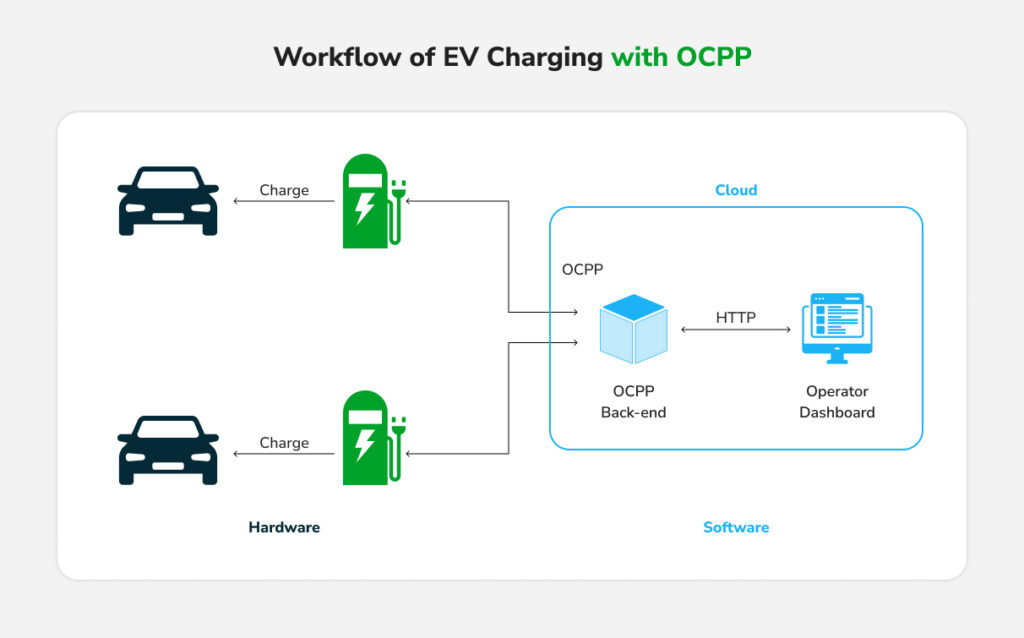
OCPP (Open Charge Point Protocol) is the communication standard that allows an EV charger to communicate with its Charging Management System (CMS).
Think of OCPP as the bridge between the physical charger and the software used to manage it.
Whenever an operator wants to check if a charger is online, update its software, monitor charging sessions, or receive fault alerts, that communication happens through OCPP.
Without OCPP, every charger manufacturer would need proprietary software, making it difficult for businesses to manage chargers from different brands.
How OCPP Works
Key Features of OCPP
OCPP makes EV charging stations easier to manage, maintain, and scale. It enables:
- Remote monitoring of charger status, availability, and sessions in real time from a central dashboard.
- Remote start and stop of charging sessions.
- Over-the-Air (OTA) firmware updates to improve performance, add new features, and address security vulnerabilities.
- Real-time charger fault detection and diagnostics, facilitating faster troubleshooting and reduced downtime.
- Smart charging, where the central system optimizes charging based on grid capacity, electricity tariffs, or user preferences.
- Dynamic load management, allowing the central system or a local controller to distribute available electrical power across multiple chargers to prevent overloads and improve energy efficiency.
- User authentication via RFID cards, mobile apps, or other approved methods, typically routed through the central system before a charging session begins.
- Transaction and energy reporting by recording charging sessions, energy consumption, and transaction details to support billing, reporting, and operational analysis.
- Vendor independence by allowing charging stations to work with compatible Charging Management Systems (CMS), reducing reliance on proprietary software.
- Scalability by making it easier to add new chargers, sites, or software integrations as charging infrastructure expands.
💡 Did You Know?
OCPP is developed and maintained by the Open Charge Alliance (OCA), a global consortium promoting open standards for EV charging. It is one of the most widely adopted communication protocols worldwide.
What is OCPI?
OCPI (Open Charge Point Interface) is an open communication protocol that allows different EV charging networks to share information. It enables features such as EV roaming, charger discovery, and seamless payments across multiple networks.
While OCPP manages communication between a charger and its backend software, OCPI connects the businesses behind those chargers.
How OCPI Works
Here’s a simplified view of how OCPI works.
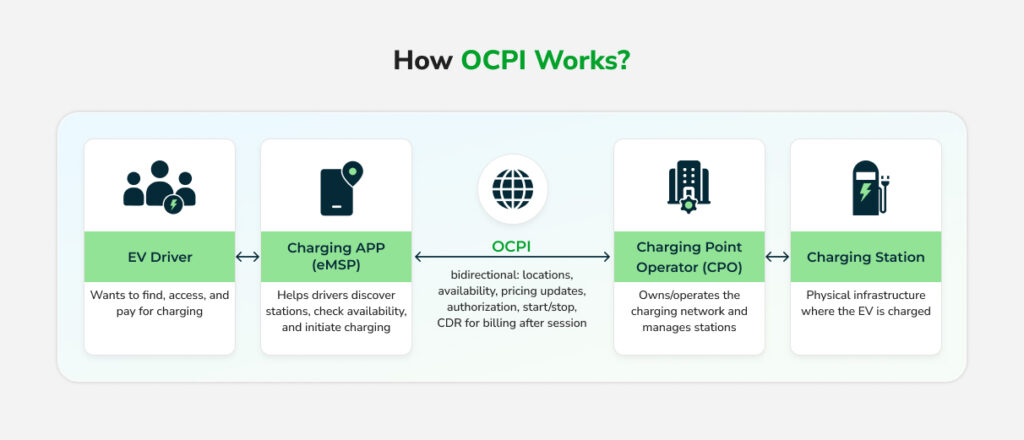
Imagine Priya uses App A to locate and pay for charging sessions. On a highway, she finds a charger that belongs to Network B.
Without OCPI:
- App A cannot communicate with Network B.
- Priya must download another app, create an account, and pay separately.
With OCPI:
- App A communicates with Network B through OCPI.
- Priya starts charging with her existing app, while the two companies exchange session and payment details securely in the background.
From the driver’s perspective, the experience feels seamless.
Key Features of OCPI
Open Charge Point Interface (OCPI) is a protocol that enables roaming between EV drivers, e-Mobility Service Providers (eMSPs), and Charge Point Operators (CPOs), allowing drivers to use charging stations outside their home network through a single app.
- OCPI enables roaming by allowing an eMSP’s app to authorize and start charging sessions at stations operated by a different CPO without requiring direct commercial or technical integrations between every network.
- It supports location and status sharing, with CPOs publishing real-time data on charging station locations, connector types, availability, and operational status to connected eMSPs.
- It facilitates dynamic pricing and tariff exchange, enabling CPOs to share per-kWh rates, session fees, time-based pricing so eMSPs can display accurate costs to drivers before charging.
- It provides remote authorization by validating a driver’s token (app credential or RFID) with the CPO in real time before a charging session begins
.
- It supports session management, allowing charging sessions to be started or stopped remotely while tracking live session data as it progresses.
- It standardizes charge detail records (CDRs), ensuring completed sessions include energy delivered, duration, and cost to support automated settlement between CPOs and eMSPs.
- It offers peer-to-peer or hub-based connectivity, supporting either direct bilateral connections or routing through a roaming hub to reach multiple partner networks with on integration.
- It uses a RESTful, stateless architecture based on HTTPS/JSON API calls, distinguishing it from OCPP’s persistent charger-to-CMS communication.
- It ensures vendor and network independence by working across different CMS platforms and charging networks, reducing the need for custom point-to-point integrations.
- Finally, OCPI continues to evolve, with version 2.2.1 widely adopted today and version 3.0 adding support for ISO 15118 and Plug & Charge capabilities.
Difference Between OCPI and OCPP
The difference between OCPP and OCPI is that OCPP manages the charger, and OCPI connects charging networks.
Let’s break down how they work together in the EV charging ecosystem:
- The EV driver opens a charging app and selects a nearby charger.
- The app communicates with the Charging Point Operator through OCPI to verify charger availability and authorize the charging session.
- The CPO sends the request to its Charging Management System.
- The CMS communicates with the physical charger using OCPP.
- The charger starts the session, and once complete, details flow back through the same chain for billing and payment.
The driver experiences a seamless process, even though multiple systems are working together in the background.
Who Uses OCPP and OCPI Protocols?
Common Misconceptions About OCPP and OCPI
Several misconceptions often create confusion around EV charging protocols.
- “OCPI replaces OCPP.” Incorrect. OCPI and OCPP serve different purposes. OCPP manages communication between chargers and the charging management system, while OCPI connects charging networks and e-mobility service providers.
- “You only need one protocol.” Not always. Private charging setup may only need OCPP, but public networks benefit from both.
- “OCPP and OCPI perform the same function.” No. OCPP focuses on charger operations, while OCPI focuses on interoperability.
- “These protocols only matter for large networks.” Not true. Even smaller networks benefit from open communication standards. Using interoperable protocols today makes it easier to scale operations, integrate new software, and participate in larger charging ecosystems in the future.

Frequently Asked Questions
What is the difference between OCPI and OCPP?
OCPP manages communication between EV chargers and Charging Management System (CMS), while OCPI enables communication between Charging Point Operators (CPOs) and eMobility Service Providers (eMSPs) to support EV roaming and interoperability.
Can an EV charging station work without OCPP?
Yes, but with limited functionality. Without OCPP, operators cannot remotely monitor chargers, receive fault alerts, perform firmware updates, or integrate with a central management platform.
Does OCPI replace OCPP?
No. OCPP and OCPI serve different purposes. OCPP manages charger operations, while OCPI enables communication between charging networks.
Why is EV charging interoperability important?
EV charging Interoperability allows chargers, software, and charging networks from different providers to work together, giving businesses flexibility and EV drivers access to more stations through fewer apps.

Sep 30, 2026 • EV Charging Infrastructure
EV Charger Buying Checklist: Everything to Compare Before You Purchase
Read More
Sep 11, 2026 • EV Charging Infrastructure
Charging During Power Cuts: What Actually Happens and How to Plan Ahead
Read More
Sep 08, 2026 • EV Charging Infrastructure
Best Ways to Set Up an EV Charging Infrastructure
Read More